
“A story straight out of Hollywood”: How a Dunstable soldier managed to escape the Nazis and make it home for Christmas

As we get closer to Remembrance Sunday and Armistice Day, Olivia Preston looks at a book that drives home the reality of war with the tale of how one soldier from Dunstable defied the odds and escaped from the hands of the Nazis – in his own words.
I first came across ‘Blighty or Bust’ a few months ago when David Wilkins, the editor, told me how he had found this story.
David explained how that he had bid on a box of notebooks in an online auction and was astounded to find an 80,000-word manuscript, all written in pencil, by a soldier in the 1940s.
He told me: “I gambled on a modest auction lot and suddenly found myself the owner of this fantastic and thrilling lost story.”
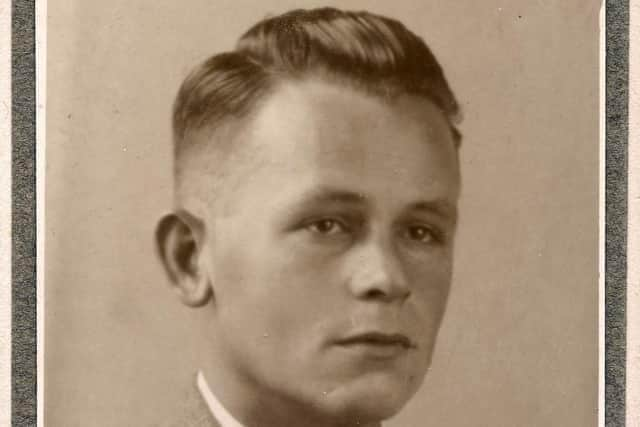

The notebooks revealed an in-depth account of how Private Raymond Bailey, a young man from Dunstable, came to escape occupied France as a prisoner of war and make it all the way home.
David explained: “Ray is probably now the youngest Second World War soldier known to have written at such length of his experiences. His memoir may even be the earliest first-hand soldier’s account of the Second World War to have been written at all. I could scarcely believe what I had found.”
As a history buff, with a particular fascination for the Second World War, I was so happy when I received it in the post, with a special message from David.
I wasted no time getting stuck into it and found it hard to put down. This was for several reasons: Firstly, for someone who was not a professional writer, Ray definitely knew how to tell a story and keep you hooked. But as he explained in later chapters, that may have been down to him having to tell it over and over to friends and family on his return to Bedfordshire.

Another reason I found this to be a page-turner was the language he used. I enjoyed reading this, knowing it was coming from someone who had lived and survived, and seen the worst in humanity, but described his journey with such delicacy and purpose.
To make more sense of Ray’s words, David started chapters with some contextual notes – pointing out what was known (or wasn’t) by the forces on the ground, and how Ray’s thoughts signalled wider feelings across the armed forces at the time. The helpful pieces of context helped me anchor Ray’s words and understand just how serious the situation was.
Whether it’s the friends he makes along the way, like Jock and Gus, or the scenic landscapes he describes, sometimes it was easy to forget the harsh reality of war that Ray faced daily.
Ray is rather clinical in his writing, not talking about the unspeakable things he sees on his 2,000-mile journey. David’s notes gave a sense of the daily reality faced by Ray, adding in quotes and short extracts from other soldiers’ very candid, albeit, graphic depictions of the German’s cruelty to both POWs and civilians.
His thoughts as he decided when and how to make his escape made for some interesting reading. He captured the anticipation and heart-thumping suspense as he dared to run and hide in bushes in a bid for freedom which, as he explained, could have easily cost him his life.
In his mind, it was almost certain death if he were to stay marching in that POW column for miles to an unknown destination. He made the choice in a split second to go for it.
As a 22-year-old, Ray would have spent hours remembering, writing and editing his account back home in Britain. I have no idea how he was able to recall it all, especially without any of the modern technology we rely upon now to jog our memories. He did manage to write a few towns on scraps of paper, but largely, Ray had it all stored away in his head.
The most profound thing for me was the help that Ray was given by ordinary people in France and Spain. Ray reflects on this and how it was mostly women who came to his aid in times of desperation: Madame Benoit who smuggled him into her home where he stayed for six weeks, a friend of hers who created a fake identity for Ray and had an official ID card signed by a Nazi officer for him, and a little Spanish girl who helped him evade the Civil Guard by telling a joke and getting Ray to laugh along with her.
Civilians came to his aid out of the goodness of their hearts at a time when being accused of treason was a death sentence.
It really is a story straight out of Hollywood, as I couldn’t believe that some of the parts were true.
The afterword shows the meticulous detail and depths that David went to create this book, making sure he did Ray justice in telling his story, which had be hidden for 80 years.
It’s astonishing to think that without David and his keen eye for spotting interesting auction lots, this amazingly heroic, true story written by a humble young man from Dunstable about how he escaped from the clutches of the Nazi war regime and lived to tell the tale, would have never been heard.
Whether it's his memory of every tiny town or bombed village he passed through on his painstaking journey to find the British Consul or his talking about finally eating Christmas dinner with his family in Dunstable, I think everyone can find something powerful to take away from this book.
Ray’s story is one of resilience, the kindness of strangers, and sheer luck.
Click here to order your own copy of Blighty or Bust.