
Inspirational undergraduate who grew up in Luton shortlisted for prestigious award
On 10th July 2025, Zack Islam, who grew up in Luton, will be celebrated at the seventh annual Student Social Mobility Awards, for overcoming adversity and achieving exceptional accomplishments in their studies and beyond.
What is your story?
Growing up in Luton and attending one of the lowest-performing state schools in the UK, my path to higher education was far from straightforward. I was the first in my family to go to university and relied on free school meals throughout my education. On A-Level results day, I was rejected by both my firm and insurance university choices, which left me heartbroken, but I refused to give up. I earned a place at the University of Exeter, where I now study Human Sciences with Proficiency in Law and am predicted to graduate with First Class Honours.
Despite the odds, I’ve worked tirelessly to create opportunities not only for myself, but for others. I was awarded the prestigious ‘Student of the Year’ at Exeter, serve on university equality and employability committees and am a recipient of the J.P. Morgan Opportunity Bursary and the Exeter Scholars Access Scholarship. As President of the Asian Society, I led the team to win four major awards and hosted the campus’ first-ever Diwali celebration, featured on ITV News.
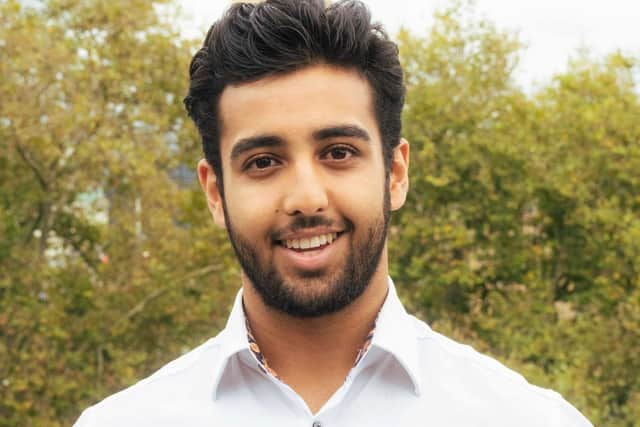

Beyond academia, I’ve boxed competitively, winning three out of four fights and secured a 2024 Summer Internship at J.P. Morgan in Investment Banking. Through my work with social mobility organisations like UpReach, SEO London and Zero Gravity, and by mentoring students across the country, I’ve committed to lifting others as I climb.
This nomination is not just for me - it represents every student who was ever underestimated because of their postcode.
How did you find out about the Student Social Mobility Awards, and how did you feel when you were shortlisted for an award?
I first found out about the Student Social Mobility Awards through other upReach Associates I met while on the programme. They introduced me to the awards and later nominated me themselves, which made the recognition feel all the more personal and meaningful. Being shortlisted genuinely made me proud - it’s humbling to know that those who’ve witnessed my journey and efforts first-hand see me as a champion of social mobility.
This nomination feels like validation of everything I’ve worked for: from mentoring students from similar backgrounds, to leading inclusive initiatives at university, to constantly striving to open doors that once felt shut. It’s a reminder that our stories matter, and I hope mine inspires others to believe that where you start does not define where you can go.
What are you looking forward to most about attending the Awards Ceremony?
I’m most looking forward to the opportunity to connect with other inspiring students who, like me, have been driving social mobility forward across the UK. Being in a room full of people who’ve overcome adversity and worked hard to create change is something truly special. I know I’ll walk away from the evening even more motivated and energised to continue championing access, equity and opportunity.
I’m also really excited to attend the event at Mansion House - such a prestigious and historic venue. It’s not every day you get to celebrate your journey in a space like that. I believe it’s the official residence of the Lord Mayor of London, which adds even more significance to the evening. I’ve never attended an awards night of this scale before, and I’m looking forward to soaking in the experience, expanding my network and celebrating how far we’ve all come.
What would it mean to you to win at the 2025 Student Social Mobility Awards?
Winning at the 2025 Student Social Mobility Awards would mean the world to me. It would be a moment of deep pride - not just for myself, but for everyone who’s walked a similar path. From growing up in Luton, attending one of the UK’s lowest-performing schools, to now walking into J.P. Morgan’s Canary Wharf office, it would be a full-circle moment that shows what’s possible when potential is given a chance.
Standing on that stage, holding the trophy, would feel like validation of every late night, every setback and every fight to belong. But more than anything, it would be a platform, one that gives me greater visibility to continue advocating for social mobility, mentoring others and showing that no dream is too big, no background too small. It would send a message loud and clear: anyone can do anything.
What barriers have you faced when entering into higher education and thinking about your future career? How has this impacted your thoughts on social mobility?
Growing up, I didn’t see university as something people like me did. No one in my family had ever gone, and the idea of higher education felt distant - almost impossible. I was fortunate to have supportive parents who, despite financial worries, encouraged me to push beyond what we knew and apply. Even then, I was reluctant. The cost, the unknown and the fear of not belonging weighed heavily on me.
Since starting university, I’ve had to juggle multiple part-time jobs alongside my studies to stay afloat financially. Working as a McDonald’s crew member, a catering assistant, and a student ambassador while studying full-time has been exhausting, but it’s also made me more determined. I’ve had to seek out every opportunity on my own, often navigating internships, applications and networking without any guidance.
Organisations like upReach, Sutton Trust, Zero Gravity, The Brokerage and SEO London have been instrumental in helping me believe in my potential. They offered mentorship, access, and opportunities that I simply wouldn’t have found otherwise. These barriers have shaped my passion for social mobility - I’ve lived it, and now I fight for it. I know how much potential is wasted simply because students don’t have the access, awareness or support. That’s why I’m committed to changing that.
The Student Social Mobility Awards showcase outstanding achievements made by students from lower socio-economic backgrounds across the UK, creating role models for others from similar backgrounds. Would you like to tell us about a role model of yours?
Role models are powerful because they give you something society often doesn’t when you come from a lower socio-economic background - permission to dream. For me, one of my earliest role models wasn’t a celebrity or CEO, but my mum. She raised our family with very little, yet gave everything to ensure I had opportunities she never had. Her resilience, selflessness and quiet strength taught me that success isn’t just about personal gain, it’s about lifting others with you.
Now, I try to be that kind of role model for students who don’t see themselves represented in professional spaces. Whether it’s through mentoring, speaking at events or sharing my story, from a free school meals student in Luton to a J.P. Morgan intern, I want others to know that their background isn’t a barrier; it’s a badge of honour. I believe role models show what’s possible, and I hope I can be that spark for someone else the way my mum was for me.
Where did you grow up and how do you feel that impacted your academic journey and how you think about your future career?
I grew up in Luton - a town often associated with a high crime rate and one of the lowest university progression rates in the country. It was an environment where the odds were stacked against young people like me. Academic ambition wasn’t the norm, and professional role models were few and far between. Careers in finance, law or global industries felt like distant dreams reserved for other postcodes. I didn't know these careers really existed until I started uni!
Growing up there gave me a strong sense of perspective. It made me more resilient, more resourceful, and more determined to prove that where you start doesn’t have to dictate where you finish. It also shaped the way I view my future career - not just as a personal journey, but as a platform to inspire and create pathways for others from places like mine.
While few in my hometown worked in the industries I aspired to enter, it pushed me to seek out support elsewhere, from national social mobility programmes to university networks. And now that I’ve navigated that path, I want to ensure others from Luton and similar areas don’t have to face those same barriers alone.
What advice would you give to someone studying at a state school in your hometown that is experiencing similar socio-economic challenges.
To any student at a state school in Luton, or anywhere facing similar challenges, my advice is simple: don’t count yourself out before you’ve even started. I know it can feel like the opportunities just aren’t made for people like us, but the truth is, there are so many incredible people, organisations and programmes out there rooting for you - you just have to take that first step.
Click “apply.” Send that message. Put yourself forward, even when it feels uncomfortable. Whether it’s upReach, Sutton Trust, SEO London, Zero Gravity or local mentors -there’s support out there waiting to back your potential.
You don’t need to have it all figured out. You just need the courage to keep showing up and saying “yes” to the next opportunity. I’m proof that your background doesn’t define your future - and one day, you’ll be someone else's reason to believe it too.
What do you hope this awards ceremony will do for social mobility more widely across the UK?
I hope this awards ceremony sends a strong message across the UK—that talent exists everywhere, but opportunity doesn’t. By celebrating the achievements of students from lower socio-economic backgrounds, we highlight the urgent need to level the playing field. I want policymakers, educators and employers watching to recognise that social mobility isn’t just about individual success stories, it’s about structural change.
My hope is that this ceremony inspires real policy shifts: more investment in state education, greater access to work experience for those without connections and targeted efforts to close the attainment and opportunity gap between state and private school students. This event is proof that when you give people a chance, they rise - and the UK has everything to gain from making that the norm, not the exception.
As a current/former upReach Associate, can you tell us about your experience with upReach?
My experience with upReach has been genuinely life-changing. Without it, I honestly don’t think I would’ve achieved half of what I’ve listed on my CV. From the start, my Programme Coordinator, Sawda, believed in me and supported me every step of the way. She helped me prepare for interviews, sharpen my CV and cover letters and gave me the confidence to apply to roles I never thought were within reach.
Through upReach, I took part in countless insight days, video forums with top employers, interview mock sessions and skill-building workshops. Most importantly, upReach helped me understand what actually happens behind the doors of those glass skyscrapers in Canary Wharf, something that once felt so distant and unrelatable.
If I hadn’t joined upReach, I would’ve lacked both the knowledge and the network to break into competitive industries. It didn’t just give me access - it gave me belief. I owe so much of my university and career journey to the guidance and opportunities I received through the programme.
Can you talk about your experience of engaging with the Banking, Finance and Insurance sector?
Being nominated for the Banking, Finance & Insurance Sector Award means a great deal to me because I’ve always seen this industry as one typically reserved for the most fortunate; those born into networks, not navigating their way from scratch. That’s exactly why I chose to pursue it. I wanted to challenge myself by entering a space that rarely sees people from my background, and in doing so, open doors for others to follow.
My degree in Human Sciences with Proficiency in Law has given me an interdisciplinary lens, helping me understand both people and policy - essential skills in a sector driven by global trends and human behaviour. I’ve gained hands-on experience through a 2024 Investment Banking Summer Internship at J.P. Morgan, numerous insight days across the industry and by taking part in technical training and market simulations. These helped me build skills in financial analysis, pitching, relationship management and working under pressure.
But beyond the technical side, I’ve developed resilience, confidence and purpose. I aspire to work in investment banking or asset management, not just to succeed personally, but to have the biggest impact possible, showing others that social mobility doesn’t stop at getting a degree. It continues into the boardrooms, trading floors and executive teams. If I can be the first, I won’t be the last. I want to be the start of a snowball of change.