
Luton History: "Before their eyes was a glorious Field of Cloves"

Local historian Jackie Gunn is on a mission to share stories of Luton's yesteryear. Join her to revisit the past as she researches the town's buried secrets…
St. Andrew's Mission Hall, a modest brick and iron corrugated building stood on the corner of Crawley Road and Gas House Path, Luton.
Opened in 1887 for public worship, it is described as a daughter sanctuary of the larger congregation of Christ Church, Upper George Street, Luton.
After the First War, the future of this quaint little church had to be reconsidered. Shops and businesses had sprung up, and residential housing had increased the congregation to saturation point. The small Victorian Mission just couldn't cope.
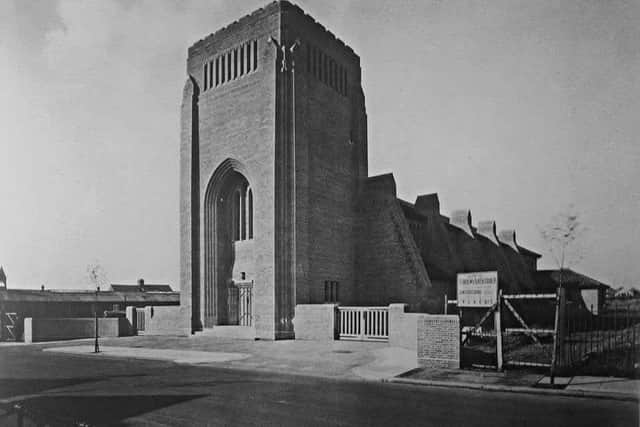
In 1920 there was a possible future for St Andrew's Church at the disused Military Camp in Biscot Road. Squire Crawley of Stockwood promised a piece of land on the Biscot Estate 10 years previously, however the land had passed into other hands, but the promise was upheld, the gift of an acre of ground at the corner of what is Argyle Avenue and Blenheim Crescent was to be the new site.
Biscot Road and the deserted First War camp were already under development; defunct wartime huts and abandoned equipment were still at the clearance stage. However, the expectations when arriving to view the site, members were pleasantly surprised - before their eyes it was a "Glorious Field of Cloves." This was the future foundation for St Andrew's-in-the Fields, Mission Church.
A small hut was a modest start until funds could be raised for a grandiose designed house of prayer. Meanwhile, a Luton gentleman, who also remained anonymous, purchased a larger than normal Military hut based in Rugby that was sufficient in size to accommodate a larger congregation. It was rapidly transported and erected. St Andrew's Church in Biscot was dedicated on November 30th 1920.
In 1927, the Rev. T.H. Pyke was appointed Priest in charge of St Andrew's. During May, the Secretary of the Diocesan Board of Finance communicated to the Church Council that an anonymous donor had deposited with the Board, securities of £5000 towards the erection of a permanent church. The gift made absolute conditionally on a further £5000 being raised locally before June 30th 1931.
An Appeals Committee was promptly formed, and so successful that by August 1930 £4000 had been reached, but raising the last £1000 was challenging. It's quoted the Vicar of Christ Church, in September, spent four days sitting in the Church Porch accepting gifts reaching a total of £872.
Finally, the counting concluded, praying they had reached the target, Mr John Gates, solicitor of the late Mrs Brooke - Tarrant, announced the lady had bequeathed £1000 towards the new Church of St Andrew's in Biscot.
The estimated cost to build St Andrew's was £16,000. Mr Arthur W. Oakley tended to the work which began in June 1931.
An additional plot of land was released to accommodate the Vicarage , as the new church rose from its foundations, gifts still poured in.
The design was architecturally futuristic; Queues were formed to celebrate the grand opening of the Festival of Consecration by the Right Rev. Father in God, Michael, Lord Bishop of St. Albans in October 1932.
The financial donors remain anonymous; The quaint little St. Andrew's Mission Hall in Crawley Road, Luton lies beneath the soil under Telford House Residential Flats.