
Luton History: Skelton's bespoke boots and shoes, and of course "The Luton News"
Local historian Jackie Gunn is on a mission to share stories of Luton's yesteryear. Join her to revisit the past as she researches the town's buried secrets…
Marcus William Skelton, born 1865 in Luton was the 3rd generation Bootmaker of the Skelton family.
His father, John Ebenezer Skelton, moved from Devon to Luton in the early 1860's, settling in Adelaide Street then finally moving to Dallow Road.
Marcus attended Langley Street School and Waller Street Senior School, he recalls Mr J. E. Arnold the headmaster at the time.


At fourteen years of age, he was apprentice bootmaker working for his father at 31 Wellington Street, Luton.
Marrying in 1898, he opened his own shop at 15 Upper George Street, Luton (Farmers Music Shop) advertising "Leggings, Gaiters Spats, Handsewn Bespoke Boots and Shoes in the newest shades of cloth and leather,- all in the latest Styles".
While the majority of British Boot making centred around Northampton, Luton boasted numerous outlets as indicated on the census records, especially towards the First War, the presence of the shoemaking industry demonstrated a large contribution towards the War effort at the time.
Making and repairing the typical standard shoe was the regular trade, however customers who suffered the misfortune of mal-formed feet approached Marcus's skills to design specialised footwear, providing the client with a good quality comfortable pair of boots or shoes.
From plaster casts or drawings from the customers feet, special wooden lasts with the abnormal shapes were built up in leather, the soles and uppers also designed with the aid of lasts, then finally hand sewn together resulting in the perfect pair of Boots to suit one's feet.
During the First War, Mr Skelton spoke of the dying trend in young men learning the trade of boot and shoe making, he said: "The need for hand-made footwear was overtaken by the production of automated machined shoes, stuck together with glue".
In 1917, Mr Skelton moved to Hastings, taking his regular client list with him, he says: "My customers order 6 or 7 pairs of shoes at a time, so I'm kept very busy".
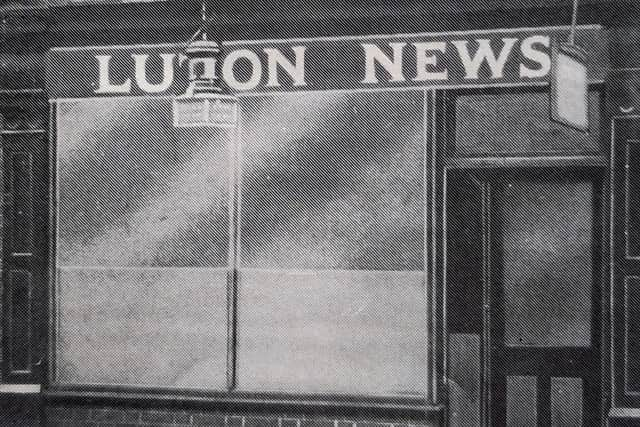
Returning to Luton in 1936, he spoke proudly of his birth town, - his father's Wellington Street business was just a few doors away from the newly opened Luton News Office at No. 6 Wellington Street, he said: "I was one of the first to purchase the 1891 1st edition of "The Luton News".
He added:, "At the age of 14, he remembers Luton receiving its Charter of Incorporation and the first elected Mayor of Luton, Mr William Bigg in 1876".
Bury Park was non-existent, and there very few houses apart from a couple of cottages in Dunstable Road near the Gas Works, Beech Hill was just a narrow winding lane.
The purpose for his visit to Luton was to view the progress of the New Town Hall, he was very complimentary, saying: "It will be a great improvement when finished, but I do hope they keep the Licence of the Dew Drop Inn".
He remarks of the old days when they dined at the Town Hall, if you tipped the waiter fourpence, he would run next door to the "Dew Drop" and purchase a bottle of beer for you, it would be a great mistake to let the Licence lapse.
Mr Skelton's move to Hastings never altered his ardent interests in Luton's progress and development, he was a regular reader of the Luton News - so much, that even on moving house, he requested the newspaper to be sent to his home in Hastings every week, the delivery continued for over 20 years.
Marcus William Skelton passed away in 1948.