
Luton Yesteryear: Skefko at the Peace Day Pageant
Depictions of the now infamous 1919 Peace Day Riots often focus on the burning Town Hall and jostling crowds. It’s easy to forget that, before Luton made national headlines for its ‘outbreak of hooliganism’ and ‘wild street scenes’, many locals were looking forward to a day of peaceful and enjoyable festivities.
Central to the programme of events was a decadent procession. As the Luton News shared in the lead up to the celebrations planned for the 19th of July, floats were to assemble at Luton Hoo Park at 2pm before making their way to Wardown Park via Park Street and George Street. As seen here, girl scholars in the procession were to wear white dresses. Decorated cars, ‘emblematic of war industry’, were to be an important feature of the procession, and Skefko Ball Bearing Co provided the vehicle shown here.
Other businesses involved in the parade included Hewlett & Blondeau, Hayward Tyler, George Kent Ltd, Frinkers Metal Co, and Vauxhall Motors. Also in the procession were the bands and the detachments of the Army, Navy, Air Force, Prisoners of War, Volunteer Force, YMCA, Boy Scouts and Girl Guides. Other planned events included tennis and bowls tournaments and a children’s tea party as well as fireworks and illuminations.
When this photo was taken at Luton Hoo on that fateful Saturday morning, organisers were disappointed to find that the weather was overcast, and rain soon began to fall. The procession set off slightly later than planned, and by the time the parade hit the Ivy Leaf Club on Park Street, it was already facing hostilities. The National Federation of Discharged and Demobilised Soldiers and Sailors (DS&S) had gathered to protest, with a banner reading ‘We do not want processions. We want work’. By the end of the weekend, the town’s Mayor was in hiding, shops had been looted, the Town Hall was a smouldering ruin, and the military had taken charge of the streets.
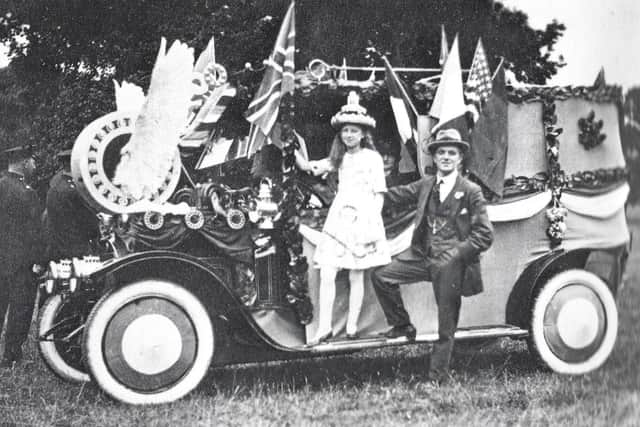

Skefko, which paraded this handsome car adorned with ball bearings, was one of many local firms which played an important role in the war effort. The factory provided parts for aircraft, gun mountings, and other machinery. To meet the increased demand for bearings during World War I it was decided to double the size of the Luton factory, enlarge the stores, and add the main office block, thereby multiplying the total floor area by more than eight times. By the end of World War I, Skefko’s 775 employees had doubled the 1914 production with a monthly output of 24,000 bearings.
In 2024, the company’s Sundon Road factory closed its doors for the last time after over a century of production on the site, resulting in over 300 job losses.