
Why a Luton writer’s latest work speaks to the global human condition
Some stories refuse to die. They wait, quietly, patiently, until the world is ready to hear them.
ExCo
Kagoj, a documentary-novel written by a Luton-based author but rooted in rural Bangladesh, is one such story. Conceived more than two decades ago, it remained buried under time, circumstance, and silence. Today, it re-emerges not as nostalgia, but as warning; not as memory, but as witness.
Though its landscapes are Bangladeshi—mud paths, village ponds, classrooms ruled by fear—its questions are unmistakably global:

What happens when education becomes a tool of discipline rather than liberation?
When merit is promised, but dignity is denied?
When children are taught obedience before thought?
Why Kagoj had to wait:
Kagoj began life in the early 2000s as a film script, intended to follow a group of village boys chasing education as their only escape from inherited poverty. That film was never made. But the delay proved prophetic.
Had the story appeared then, it might have been read as local social critique. Today, it reads as something far more urgent: a diagnosis of a global condition. Across continents, from South Asia to Britain, education systems are under strain, classrooms are politicised, and children are increasingly measured by outcomes rather than understood as lives.
The long silence gave the story perspective. Time stripped away sentimentality and sharpened its truth.
From Bangladesh to Luton—and beyond:
Writing this book from Luton adds an unspoken layer. Luton is a town shaped by migration, labour, aspiration, and intergenerational hope. Many families here understand what it means to invest everything in education—sometimes across oceans—believing it to be the great equaliser.
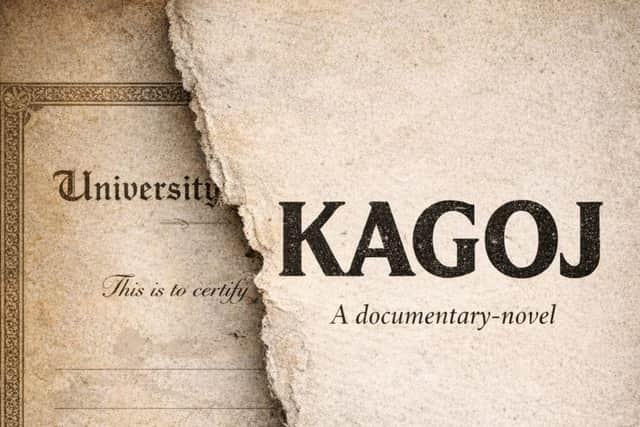
Kagoj speaks directly to that faith. It shows how certificates—kagoj, pieces of paper—become sacred objects, carrying parental sacrifice and social promise. Yet it also reveals how those papers can turn weightless when systems are indifferent or cruel.
This is not just Bangladesh’s story. It is the story of any society that celebrates education rhetorically while practicing exclusion quietly.
A brutal honesty we rarely allow:
What makes Kagoj unsettling is its refusal to soften brutality. Children are beaten in classrooms. Fear replaces curiosity. Intelligence survives in spite of authority, not because of it. Girls are brilliant yet constrained. Boys learn early that silence is safer than truth.
There is no heroic escape here. No cinematic redemption. Only accumulation—of pressure, humiliation, resilience, and loss.
In an age obsessed with inspirational narratives, Kagoj insists on honesty. It reminds us that for millions, education is not a ladder but a narrow corridor lined with threats.
Why it matters now:
We live in a time when global conversations about inequality often float above lived reality. Kagoj drags those conversations back to the ground—into bodies, classrooms, villages, and families.
That is why this story, delayed by 22 years, arrives exactly on time.
From Luton to Dhaka, from villages to cities, Kagoj asks us to confront an uncomfortable truth: systems rarely fail by accident. They fail by design—and children pay the price.
This is not a book about Bangladesh alone.
It is about what happens when societies break their promises to the young.
And that, wherever we live, should concern us all.