
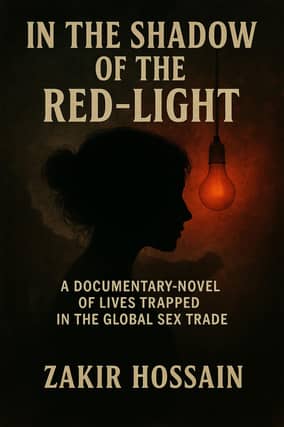
Why Luton filmmaker wrote 'In the Shadow of the Red-Light' - documentary-novel tackling the global sex trade

This article contains affiliate links. We may earn a small commission on items purchased through this article, but that does not affect our editorial judgement.
“That night I felt for the first time what it was like to be a whore. I had to service eight men... I felt so terrible and ashamed… I showered after every encounter, but I could not wash away the filth in me…”
This is not a line crafted for shock value. It is the voice of a character, yes—but it carries the weight of many real voices I encountered during the years I spent researching the global sex trade.
In the Shadow of the Red-Light is not just a novel. It is, in many ways, my personal refusal to look away.
I first entered this world in 2001 while writing and directing a documentary on human trafficking for USAID. Later, I was asked to develop a drama-documentary on sex trafficking for the South Asia Foundation. What began as film projects soon became something much larger. I began interviewing survivors in Bangladesh—women and girls who had been rescued from brothels, private homes, and international trafficking rings. I spoke with social workers, counsellors, and law enforcement. I studied reports, legal frameworks, and case histories. I combed through online forums, trafficking databases, academic papers, and underground channels. The deeper I went, the more devastated I became. It wasn’t just the brutality that overwhelmed me. It was the scale. And the silence.
Trafficking today is the third-largest criminal enterprise in the world after drugs and arms. And the sex trade, especially in South Asia, is one of its most insidious forms. Girls are lured from villages with promises of jobs, love, or marriage. Some are sold by their own families. Others are abducted. Most are underage. Many never return.
I realised early on that no documentary or policy paper could fully capture the human complexity of this crisis. Facts alone would not shake people. What we need are stories that don’t just inform, but disturb. Stories that make us stop. That’s why I wrote this book.
In the Shadow of the Red-Light is a hybrid novel, a drama-documentary that blends fiction and testimony, realism and symbol, silence and resistance. It follows multiple characters across Bangladesh, Nepal, and Sri Lanka. Moyna, a spirited girl from a starving village. Anusha, a single mother in Colombo forced to make an impossible choice. The twin sisters Abhijita and Abhilasha, chasing dreams in Kathmandu’s film world. And many others. Some of these characters are based on real survivors I interviewed. Others are composites. All are shaped by truth.
I chose to write this book in a cinematic, almost poetic style, because the reality itself is cinematic—stranger and more brutal than fiction. In places, the language is lyrical. In others, unfiltered. I did not censor what was said to me. I did not dress up the ugliness. Because the truth is ugly. But ignoring it is worse.
This book is not about heroes and villains. It’s about systems. The system of poverty. The system of patriarchy. The system of impunity that allows men to buy girls as easily as they buy cigarettes.
It is also about resilience. Some characters fight. Others survive. Some disappear. Some return. All leave a mark.
When I first wrote In the Shadow of the Red-Light in 2014, I thought it might be a one-time attempt. But the problem hasn’t gone away. It has only grown—migrating online, shifting shape, finding new markets, new victims. So in 2025, I revised and republished the book. Not because the story has changed, but because it hasn’t.
I didn’t write this book because I had the answers. I wrote it because I couldn’t stay silent. Because these girls, these women, deserve to be heard, even if through fiction.
If you believe literature still has the power to confront injustice, I invite you to read this novel. Not as entertainment, but as witness.
In the Shadow of the Red-Light is now available worldwide on all major platforms.
If the book moves you, I would be grateful if you help me share it. This is not about sales. This is about stories that are still being buried. Lives still being sold.
We often say, “someone should do something.”
This is my something.
— Zakir Hossain