
Dunstable Yesteryear - Snowdrifts drama
A drama on the Watling Street at Hockliffe, when a mail coach and other vehicles became stuck in a heavy snowdrift, became the subject of a famous engraving published on February 6 1837.
A drawing of the incident had been made by Henry Thomas Alken (1785-1851), well-known for his paintings of racehorses and sporting events.
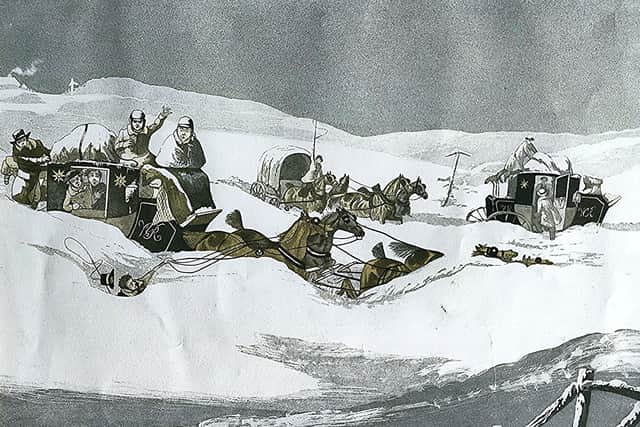

His drawing was then used as the basis for an engraving by Robert Havell (1783-1878), famous for producing many of the colour plates used to print Audubon’s four-volume masterpiece The Birds of America.
The engraving reproduced here, originally published by Robert Havell at 77 Oxford Street, was captioned “Holyhead and Chester Mails at Hockley Hill, near Dunstable”. Hockley is the old name for Hockliffe.
The mail would have been carried in a locked and guarded container at the rear of the carriage, and although three or four passengers were allowed to travel on the vehicle, the letters took priority. There are many stories in those days of passengers having to await rescue after an accident, while the mailman unhitched a horse and rode off to make sure his deliveries arrived on schedule.
There are reports of three feet of snow falling in Dunstable in 1837, which caused mail coaches to be two hours late in arriving at Dunstable Post Office, but no specific report of the Hockliffe incident has yet been traced.
The chalk cutting through the steep hill on the outskirts of Dunstable was deepened later in 1837, although Hockley Hill might refer to the steep slope on the northern side of the village. Two years earlier a speeding stagecoach had overturned near Dunstable and two passengers were crushed.
Yesteryear is compiled by John Buckledee, chairman of Dunstable and District Local History Society.