
'Don't chuck them in the bin' Luton Astronomical Society's advice for eclipse glasses
Solar eclipse glasses could be heading to landfill after people across the UK view the celestial event
But Luton Astronomical Society is offering advice on what to do once the spectacle is over.
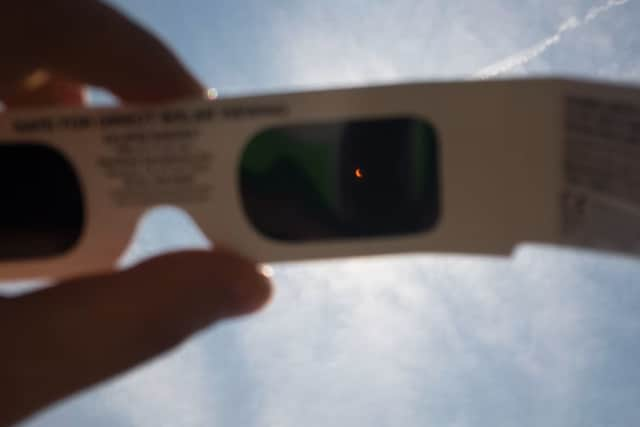

Phillip Price, a member of the Luton Astronomical Society, said: “Don't chuck'em in the bin. Instead, keep them. We've got partial solar eclipses for the next three years. As long as they're not damaged, you can use them again.
"If they are damaged, just peel off the lenses and pop those in the bin. Recycle the cardboard.”
BusinessWaste.co.uk says searches for “solar eclipse glasses next day delivery UK” have risen by more than 3,200 per cent in the past four days.
Figures show 152,600 sales across Amazon's top 20 best-selling eclipse-glasses products, but many are multipacks.
The glasses are typically made from thin, coated or laminated cardboard, with the lenses consisting of a polymer solar-filter film. This means the materials need to be separated if the glasses are to be recycled.
BusinessWaste.co.uk is advising people to consider donating their glasses to astronomy groups, museums or science organisations rather than throwing them away.
Astronomers Without Borders has previously operated a collection scheme for unwanted eclipse glasses, although its website currently says the programme is on pause.
Mark Hall, from BusinessWaste.co.uk, said: “The solar eclipse has got plenty of people excited, the first chance to see the significant event since 1999, with the next not due until 2090.
“Naturally, this has seen a rush on purchases of viewing glasses, with Brits scrambling to catch a glimpse of the rare wonder.
“However, many haven’t planned beyond this, stopping to consider what they will do with the glasses once the fanfare is over.”
If you don't have the special glasses, a pinhole projector can be made using leftover cardboard.
The simple device uses a tiny hole in a piece of material to project an upside-down image of the Sun onto another surface.
The eclipse is expected to be visible to around 12.1 per cent of the world's population, approximately 980 million people.
> Send us your photos of you watching the eclipse, and they might be featured in a gallery. Remember, don’t look at the sun through camera lenses unless the equipment has a suitable solar filter fitted to the front. Even when partially blocked, intense solar rays can ruin your phone's camera sensor. Never look at the sun directly through your phone screen while pointing it upward.