
Nottingham Forest fined £750,000 after calling VAR official a Luton Town fan
Independent commission dish out heavy punishment to Reds
Nottingham Forest have been fined £750,000 by the Football Association for bringing the game into disrepute after ruling that the club questioned the integrity of the match officials following their loss to Everton last season, when the Reds claimed VAR official Stuart Attwell was a Luton Town fan.
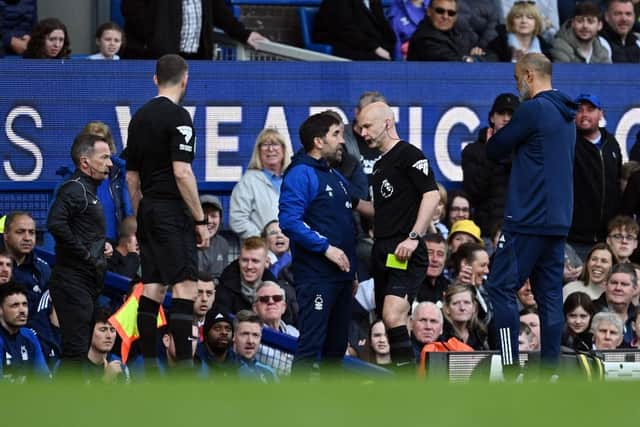
With Forest and Luton locked in a battle to stay in the Premier League once the former European champions were deducted four points due to breaking financial rules, they suffered a controversial 2-0 defeat against fellow relegation rivals Everton in April, a game that the Reds thought they were denied three clear-cut penalties, all for incidents involving Ashley Young, two for fouls and one for handball.
However referee Antony Taylor didn’t award any in favour of the visitors, and wasn’t told once to go to the monitor by the official in Stockley Park, which was Attwell. After the fixture the game, the Reds claimed they had raised concerns with the Professional Game Match Officials Limited (PGMOL) prior to the fixture about the Nuneaton-born official, stating he was in fact a Hatters supporter.

Writing on the club’s official X page following the match, they also released a statement saying: “Three extremely poor decisions - three penalties not given - which we simply cannot accept. We warned the PGMOL that the VAR is a Luton fan before the game but they didn’t change him. Our patience has been tested multiple times. NFFC will now consider its options.”
Forest had denied they had questioned the integrity of officials or brought the game into disrepute, but an independent commission found against them, with a statement saying: “Nottingham Forest have been fined £750,000 and warned for misconduct in relation to comments posted on social media after their Premier League game against Everton on Sunday 21 April.
“The club denied that the comments posted on social media imply bias and/or question the integrity of the match officials and/or the video assistant referee and/or bring the game into disrepute. An independent Regulatory Commission found the charge to be proven following a hearing and imposed the club’s sanctions.”
Discussing Attwell being named as a Town follower in more detail, the FA liability and sanction statements added: “In our judgment, a ‘reasonable bystander’ armed with some general knowledge of the sport, as clarified above, would inevitably conclude that the decisions which ‘went against’ NFFC were clearly linked to the VAR being a Luton fan and, as such, inevitably involved an implication of actual bias on his part against NFFC, and we so find on a balance of probabilities.
"It follows, in our judgment, that as the integrity of a match official has been called in to question in this way, this was improper conduct, and thus, we find the charge proved, although a finding is not strictly necessary on this point, we consider on a balance of probabilities that the means of communication of this publication, by the use of an X post (or tweet) which it was realised (if not intended) would ‘go viral’, that the game was brought into disrepute as a result.
"The fact that it was, in our view, an extremely ill-informed accusation to make because Everton FC, as fellow-strugglers in the battle against relegation, had just as much reason to be upset as NFFC about the appointment of a Luton Town supporter as (VAR) is irrelevant. There were ways in which NFFC’s concerns about VAR and grievances, such as they were, could have been aired, through an appropriate forum, or by sending an email to The FA’s Integrity Department, as advised by The FA in the Guidance Document referred to above, but NFFC chose to air them in a way which they knew would generate massive publicity, even if they were later to rue their choice of words and the way in which their grievances were received.
"Whilst we acknowledge that in certain circumstances, the deterrent effect of a suspended penalty can be a clear and compelling reason for so directing, we see no reason for doing so in this case. The Commission is satisfied that NFFC’s concerns pre-match fell well short of a request for Mr. Attwell to recuse himself and could not begin to excuse the ‘exceptionally poorly judged’ method which the Club deliberately chose to adopt as a means of conveying its concerns and anger after the match.
"That does put into context why the Club behaved in the way in which it did, and whilst it does not begin to excuse it, it at least provides a reason, albeit not approaching a justification, for its conduct. Whilst we acknowledge that the Club later rued its choice of words and the way in which its grievances were aired, by that stage the damage had been done. We reiterate our earlier finding that the subsequent posts fell far short of a genuine apology, but were in the nature of a damage-limitation exercise. There is a world of difference between an expression of regret and a genuine apology extended to an individual who has been impacted by the Club’s behaviour.”